

Microsoft releases VibeVoice-Realtime-0.5B, a lightweight text-to-speech model based on Qwen2.5. It supports streaming input and long text generation with first-word latency as low as 300ms. This article analyzes its technical architecture, performance evaluation, and usage limitations.
Imagine when you talk to an AI, it responds almost the instant you finish speaking. Does this fluidity make you feel more like you’re talking to a real person?
This is exactly the holy grail that Text-to-Speech (TTS) technology has been pursuing. Microsoft recently launched an open-source model called VibeVoice-Realtime-0.5B. This isn’t just another speaking tool; it attempts to solve the most thorny issue in current voice interaction: Latency. This model focuses on being lightweight and real-time, capable of achieving a first-word latency as low as 300 milliseconds, hardware permitting.
What does this mean? It means that while a Large Language Model (LLM) is still thinking about the full answer, VibeVoice can already start reading out the first few generated words. This “speak-while-thinking” capability is crucial for creating realistic human-machine interaction.
Let’s take a closer look at the technical details behind this model and why it stands out among numerous TTS models.
What is VibeVoice-Realtime? Core Highlights Analysis
VibeVoice-Realtime-0.5B is a text-to-speech model designed specifically for “real-time interaction.” Its core advantages lie in Streaming Text Input and Robust Long-form Speech Generation.
Unlike traditional TTS models, which usually require receiving complete sentences or paragraphs before processing audio (leading to noticeable pauses), VibeVoice adopts an Interleaved, Windowed Design.
Simply put, it slices input text into small chunks for incremental encoding while simultaneously using a diffusion-based model to generate acoustic features in parallel. This design removes the semantic tokenizer and relies solely on an acoustic tokenizer operating at a very low frequency (7.5Hz), which is the secret to its ultra-low latency.
Key Features at a Glance:
- Extremely Lightweight: With only 0.5B (500 million) parameters, it is very suitable for deployment in resource-constrained environments.
- Real-time Response: First-word sound generation latency is around 300 milliseconds (depending on hardware).
- Streaming Processing: Supports reading real-time data streams, suitable for live broadcasting or real-time translation scenarios.
- Stable Long-form: Even for long speeches, voice quality remains stable without crashing or repetition.
If you want to experience it yourself, you can run it on Colab.
Technical Breakdown: Perfect Combination of Qwen and Diffusion Models
The architecture of this model is quite interesting; it doesn’t start from scratch but stands on the shoulders of giants.
VibeVoice integrates a Transformer-based Large Language Model. Specifically, this release uses Qwen2.5-0.5B. This provides the model with powerful text understanding capabilities.
In addition, it includes two key components:
- Acoustic Tokenizer: Based on the σ-VAE variant proposed in LatentLM. This is a mirror-symmetric encoder-decoder structure with 7 modified Transformer blocks. It can downsample 24kHz audio input by an astonishing 3200 times, greatly compressing data volume and improving processing speed.
- Diffusion Head: This is a lightweight module (only 4 layers, about 40 million parameters). Its job is to predict acoustic features using a Denoising Diffusion Probabilistic Model (DDPM) based on the LLM’s hidden states.
In the inference phase, it uses DPM-Solver and its variants, combined with Classifier-Free Guidance (CFG), to generate high-quality audio.
It is worth noting that the training of this model adopted a Curriculum Learning Strategy, with context length gradually increasing from 4k to 8k tokens, which is a key reason why it can handle speech generation up to 10 minutes long.
Performance Showdown: How Does VibeVoice Perform?
In the TTS field, we usually value two metrics: Word Error Rate (WER) and Speaker Similarity.
According to Zero-shot test results on the LibriSpeech test-clean dataset, VibeVoice-Realtime-0.5B showed surprising competitiveness:
- VibeVoice-Realtime-0.5B: WER 2.00%, Similarity 0.695
- VALL-E 2: WER 2.40%, Similarity 0.643
- Voicebox: WER 1.90%, Similarity 0.662
It can be seen that although VibeVoice is a lightweight model, it even surpasses VALL-E 2 in voice accuracy and similarity, and trades blows with Voicebox. This proves that “small models,” when optimized, can still demonstrate excellent performance.
Responsible AI: Safety Mechanisms and Anti-Spoofing
As AI voice becomes more realistic, concerns about “Deepfakes” follow. Microsoft has taken a very rigorous attitude in this project.
This model is currently limited to research purposes only. To prevent abuse, Microsoft has implemented multiple safeguards:
- Removal of Acoustic Tokenizer Code: Prevents users from creating their own voice embeddings, meaning you cannot casually take a clip of a celebrity’s voice to “clone” that speaker.
- Mandatory Watermarking: Every generated audio clip automatically embeds an imperceptible watermark so third parties can verify the audio source.
- Audio Disclaimer: An audible disclaimer (e.g., “This clip is AI-generated”) is even embedded in the audio file. While this might affect some usage scenarios, it is crucial for preventing fraud.
Usage Limitations and FAQ
Before starting, there are some realistic limitations to understand. This is not an omnipotent magic box; it has clear boundaries.
Q: Can this model speak Chinese or other languages? Currently, this real-time version only supports English. If you try to input other languages, the output might be unintelligible noise or incorrect pronunciation. Training data is purely based on English.
Q: Can it be used to generate singing or background music? No. VibeVoice focuses on Speech Synthesis. It cannot generate coherent non-speech audio like background ambience, foley, or music.
Q: Can I use it for commercial products? Microsoft explicitly suggests NOT to use this model for commercial or real-world applications. It is currently for research and development use only. If you intend to integrate it into a product, you need to bear legal and ethical risks yourself, and ideally inform end-users that they are hearing AI-generated content.
Q: Does it support multi-speaker conversation generation? This Realtime variant only supports a single speaker. If you need to generate multi-person dialogue, you need to look for other VibeVoice model variants. Furthermore, it does not support modeling of Overlapping Speech.
Q: Can it read code or math formulas? Currently not supported. The model cannot accurately read code, complex mathematical formulas, or special symbols. It is recommended to preprocess text to normalize or remove such content before inputting to avoid unpredictable results.
Conclusion: The Next Step in Voice Interaction
The emergence of VibeVoice-Realtime-0.5B demonstrates the efforts of the open-source community and tech giants in driving real-time interaction experiences. Although it currently has limitations in language and usage, its architectural design proves that low latency and high quality are not mutually exclusive.
For developers and researchers, this is an excellent experimental platform to explore how to seamlessly connect LLM thought processes with voice output. As technology iterates, we might soon see multi-modal interaction models supporting multiple languages and more natural interactions.
If you are interested in technical details, you can check the VibeVoice Technical Report for more information.
DMflow.chat
Discover DMflow.chat and unlock the new era of AI-powered customer service.
Learn More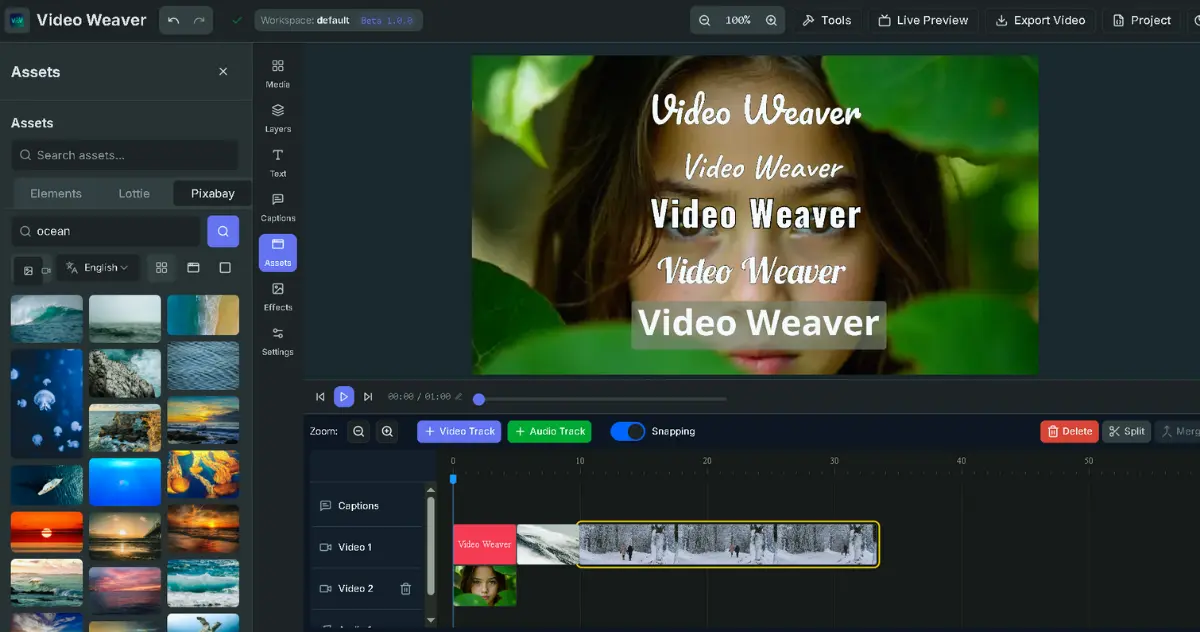
videoweaver.app
Video Weaver: Professional video editing directly in your browser. No downloads required.
Learn More
DMflow.chat
DMflow.chat: Your intelligent AI partner for exceptional customer engagement.
Learn MoreDMflow.chat
Discover DMflow.chat and unlock the new era of AI-powered customer service.
Learn Morevideoweaver.app
Video Weaver: Professional video editing directly in your browser. No downloads required.
Learn MoreDMflow.chat
DMflow.chat: Your intelligent AI partner for exceptional customer engagement.
Learn More