
Thinking Machines Lab Launches Inkling Model: 975B Open-Source Weights and Multimodal Technology Analysis
Thinking Machines Lab has finally brought out its first work. Led by former OpenAI CTO Mira Murati, this startup announced Inkling, a multimodal model trained from scratch, on July 15, 2026. This time, they adopted the Apache-2.0 license to release the physical weights of the 975B parameter model. In the current market dominated by commercial closed-source models for high-end applications, releasing weights for such a large-scale model still holds considerable value for the research community and enterprise deployment.
Interestingly, they were very frank in their official Thinking Machines announcement: Inkling is not the strongest model currently on the market. Its positioning is more like a highly balanced base that is convenient for fine-tuning and customization.
975B Parameters and Mixture-of-Experts (MoE) Design
Inkling has a 66-layer decoder architecture with a total of 975B parameters. However, because it uses a Mixture-of-Experts (MoE) architecture, only 41B parameters are actually activated per inference, keeping computational costs from becoming excessively high.
Specifically, its routing mechanism selects the 6 most relevant experts from 256 expert modules, combined with 2 resident shared experts to process tasks. The routing part adopts a Sigmoid-based router and auxiliary-loss-free load balancing bias, primarily designed to solve the common MoE problem of expert load imbalance. In the attention mechanism, local attention is alternated with global attention in a 5:1 ratio, paired with relative position embeddings to handle long text.
Encoder-free Native Multimodal Architecture
Compared to splice-style multimodal models that rely on external encoders, Inkling adopts an encoder-free native multimodal architecture. It was pre-trained on 45 trillion (45T) tokens containing text, images, audio, and video.
In visual processing, it utilizes a four-layer hMLP structure to convert images into 40x40 pixel patch encodings; in audio, it uses dMel spectrogram technology to discretize 16kHz audio signals into tokens. Because all inputs are jointly processed in the same latent space, combined with a 1 million (1M) token ultra-long context window, Inkling performs quite smoothly when understanding multimodal context.
Telegraphic Chain-of-Thought and Controllable Thinking Effort
Official technical reports indicate that in the course of training over 30 million (30M) rollouts with reinforcement learning (RL), the research team discovered an interesting phenomenon: Inkling’s chain-of-thought (CoT) evolved on its own. Initially, it used complete grammar like “We need to understand…” to organize its thoughts; but as training progressed, it removed unnecessary articles and conjunctions, shortening them into telegraphic “We need determine.” This approach does not affect the output result, but saves quite a few tokens.
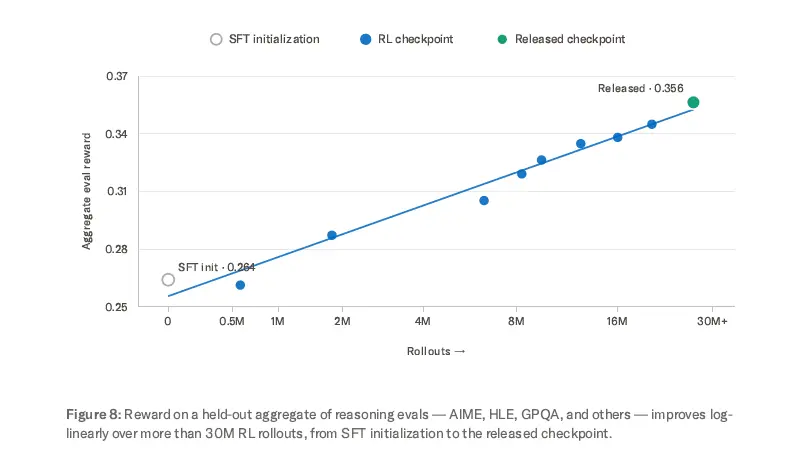 Image source: https://thinkingmachines.ai/news/introducing-inkling/
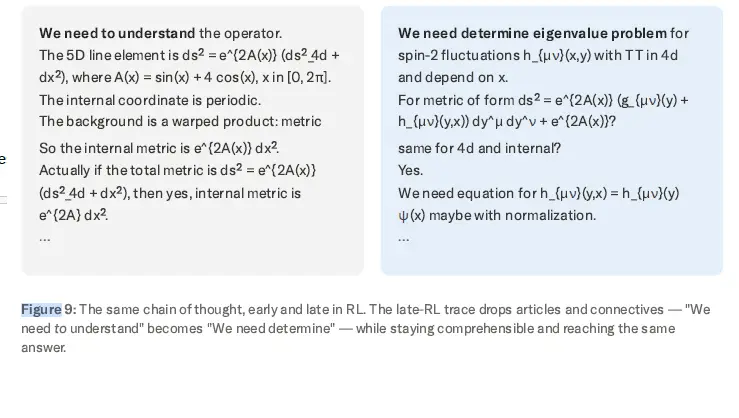 Image source: https://thinkingmachines.ai/news/introducing-inkling/
Coupled with this feature, Inkling provides a “controllable thinking effort” parameter, ranging from 0.2 to 0.99. Developers can manually adjust the model’s “degree of thinking” to control cost and precision. For example, according to official benchmarks, when achieving coding performance equivalent to Nemotron 3 Ultra on the Terminal Bench 2.1 test, Inkling only spent about one-third of the tokens used by the competitor. If you are interested in this chain-of-thought evolution, you can view their Inkling Model Card.
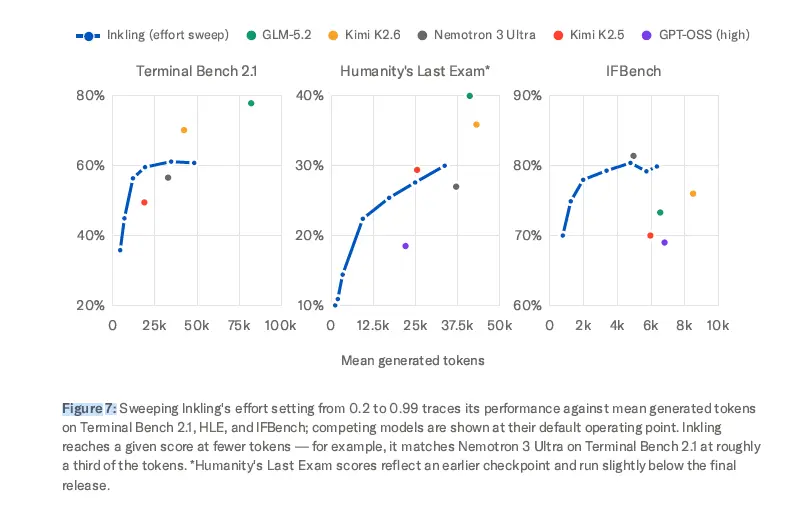 Image source: https://thinkingmachines.ai/news/introducing-inkling/
Hardware Deployment and Tinker Fine-Tuning Platform
Running a 975B model is no easy task. If using the full BF16 format, you need about 2TB of VRAM, basically requiring 8 NVIDIA B300s or 16 H200s. However, on the Blackwell architecture, you can use the optimized NVFP4 format, reducing VRAM requirements to 600GB.
If hardware resources are limited, they also provide a smaller “Inkling-Small” preview version. It has 276B total parameters, only 12B active parameters, and a much lower running threshold, making it very suitable for edge deployment or Proof of Concept (PoC). In addition, paired with their Tinker customization fine-tuning platform, the open-source version provides two context lengths, 64K and 256K. Now, developers can download these weights from the Inkling page on Hugging Face and use them with the tml-renderers package to perform inference.
Epistemology and Security Defense
In terms of security, Inkling performs well in epistemological evaluation; simply put, it knows its own knowledge blind spots. When asked about uncertain domains, it tends to give conservative, qualified guesses rather than confidently spouting nonsense.
Additionally, while blocking malicious requests, the model tries its best to avoid over-defense. In FORTRESS security evaluations, it can accurately reject harmful instructions such as weapons or violence, but its false positive rate for “seemingly sensitive but actually harmless” gray questions is quite low. According to official model card data, in StrongREJECT’s interception test for harmful requests, its score is 98.6%.
Inkling may not be the top benchmark monster, but with open-source weights, native multimodality, and telegraphic thinking efficiency, it is a very noteworthy new choice for developers hoping to deploy and fine-tune models themselves or reduce reliance on closed-source APIs.
Q&A
Q1: Since the official stance admits that Inkling is not the strongest benchmark model on the market, why should developers still choose it? A: Official positioning for Inkling is a “broad, balanced foundation model,” which deliberately avoids narrow optimization for single benchmarks. Its greatest value lies in combining “native multimodal capability,” “efficient chain-of-thought,” and developer-friendly Apache 2.0 open-source licensing. This makes it an excellent starting point for enterprises to perform customized fine-tuning for specific domains (such as autonomous agents, customer service systems, or code assistance) without being trapped in the black box of closed-source vendors.
Q2: With a volume of 975B parameters, is it feasible for ordinary enterprises to afford its hardware deployment costs? A: If using the full BF16 weights, it indeed requires up to 2TB of VRAM (equivalent to a cluster of 8 NVIDIA B300s or 16 H200s). However, the official version provides a highly flexible alternative: if deployed on the latest Blackwell architecture, you can use the NVFP4 quantized version, compressing VRAM requirements significantly down to 600GB. For teams with limited computing resources, they can also choose the upcoming “Inkling-Small” (276B parameters, only 12B active), which achieves performance close to the flagship version on many benchmarks, making it a high cost-performance choice for edge deployment and Proof of Concept (PoC).
Q3: What practical benefits does the “encoder-free” architecture mentioned in the article have when processing images and audio? A: Past multimodal models usually required external bulky independent visual or speech encoders to “translate” input content. Inkling’s approach is to throw audio (converted into dMel spectrograms) and images (converted into 40x40 pixel hMLP patches), through lightweight embedding layers, directly into the same latent space along with text tokens to be jointly processed by the decoder. This design significantly reduces the latency of cross-modal information transmission and has become the cornerstone for the official future goal of building “interactive models that support real-time voice and visual collaboration.”
Q4: How does the “Epistemology” emphasized by the official help in actual commercial applications? A: “Epistemology” implies that the model possesses excellent “self-awareness and calibration.” During training, Inkling was incorporated with “abstention-aware rewards,” which allows it to honestly answer “I don’t know” or give conservative guesses when facing issues with missing information or uncertainty, instead of confidently giving wrong information (hallucinations) just to please the user. This is a critical security defense line for enterprise-grade RAG (Retrieval-Augmented Generation) applications that “require high trust and rigor,” such as financial forecasting, scientific research, or legal statement analysis.