

Meta AI has announced the revolutionary Omnilingual ASR technology, supporting speech recognition for over 1,600 languages, especially those with scarce resources. This open-source technology not only breaks technical bottlenecks but also hopes to truly bridge the language divide in the digital world through community power.
Have you ever thought about it? There are over 7,000 languages in the world, but on the internet, we mainly use only a few. This means that the native languages of billions of people are almost ‘invisible’ in the digital world. This is not just a communication barrier, but a profound digital divide.
However, all of this may soon change. Meta’s Foundational AI Research (FAIR) team recently dropped a bombshell, launching a new Automatic Speech Recognition (ASR) model called Omnilingual ASR. This is not a small update, but a huge leap forward—it allows AI to understand and transcribe the speech of over 1,600 languages, including 500 low-resource languages that have never been successfully transcribed by AI before.
Not Just ‘More’ Languages, But a Whole New Way of Thinking
Past speech recognition systems had a major headache: they were heavily dependent on large amounts of labeled data. It’s like teaching a child to speak; you have to constantly tell them ’this word means this.’ For languages with abundant online resources like English and Chinese, this is not a problem. But for ’long-tail languages’ with fewer speakers and scarce digital data, this is an almost impossible task.
Omnilingual ASR cleverly bypasses this obstacle. It adopts two innovative architectural designs:
- Expanding the Core Model: The team expanded the previous
wav2vec 2.0speech encoder to 7 billion parameters for the first time, enabling it to extract extremely rich and cross-lingual semantic information from raw speech. - Borrowing Wisdom from Large Language Models (LLMs): The team created two decoders, one of which borrows from the Transformer decoder commonly found in LLMs. This method, called LLM-ASR, has completely changed the performance of ASR, especially when dealing with languages with scarce training data.
The result? This 7B-LLM-ASR system has achieved top-level performance in over 1,600 languages, with 78% of them having a Character Error Rate (CER) of less than 10%. Frankly, this data is quite amazing.
Bring Your Own Language: How AI Achieves Community-Driven Development?
Perhaps the most exciting thing about Omnilingual ASR is that it completely changes the way new languages are added.
Previously, getting an ASR system to support a new language required experts to perform complex and time-consuming ‘fine-tuning,’ which was too high a barrier for most communities. But Omnilingual ASR introduces an ‘in-context learning’ capability similar to that of LLMs.
What does this mean? Simply put, a user of an unsupported language can now provide a very small amount of speech and corresponding text samples to allow the model to quickly learn and produce usable transcription quality. You don’t need a huge database, you don’t need high-end computing equipment, and you certainly don’t need to be an AI expert.
This brings AI technology from the lab to the real world, turning it into a framework that can be jointly participated in and expanded by the community. Compared to other models, Omnilingual ASR has achieved a tens of times increase in the breadth of language coverage.
Not Just a Model, But a Whole Open-Source Toolbox
This time, Meta is not just publishing a paper, but generously providing a whole set of tools, hoping to empower researchers, developers, and language advocates around the world.
The resources released this time include:
- A series of models: From a 300-million-parameter lightweight version suitable for low-power devices to a powerful 7-billion-parameter model that provides top-level accuracy, there is something for everyone.
- Omnilingual wav2vec 2.0 base model: This is a general-purpose speech base model that can be used for other speech-related tasks besides ASR.
- Omnilingual ASR corpus: This is a unique dataset that contains transcribed speech from 350 low-resource languages.
- Friendly open-source license: All models are released under the
Apache 2.0license, and the data is under theCC-BYlicense. All tools are based on FAIR’s open-source frameworkfairseq2and the PyTorch ecosystem, making it easy for developers to get started.
Want to experience it for yourself? You can try their language exploration demo or download the models directly to play with.
The Power of Global Collaboration
This ambitious project is not the result of Meta working in isolation. To reach languages that have almost no footprint in the digital world, Meta has partnered with local organizations around the world to recruit and compensate native speakers to record their speech.
In addition, through the ‘Language Technology Partnership Program,’ Meta has brought together linguists, researchers, and community members from organizations such as the Mozilla Foundation’s Common Voice, Lanfrica/NaijaVoices, and others. The deep involvement of these partners has injected valuable linguistic knowledge and cultural understanding into Omnilingual ASR, ensuring that the technology can truly meet local needs.
What Does This Mean for the Future?
The emergence of Omnilingual ASR is not just a technological breakthrough; it is more like a key that opens the door to a more inclusive and equitable digital world.
When AI can understand and transcribe the languages of almost everyone, it means:
- Communication without barriers: Real-time communication across languages is no longer science fiction.
- Cultural preservation: Endangered languages can be recorded, analyzed, and preserved.
- More accessible information: People all over the world can have equal access to the knowledge and services of the digital world.
This work is part of Meta’s vision to help build a more connected world. Making high-quality speech-to-text systems accessible to the most neglected language communities is a key step in bridging the digital divide and breaking down language barriers.
In the end, isn’t the ultimate purpose of technology to make everyone’s voice heard clearly?
DMflow.chat
Discover DMflow.chat and unlock the new era of AI-powered customer service.
Learn More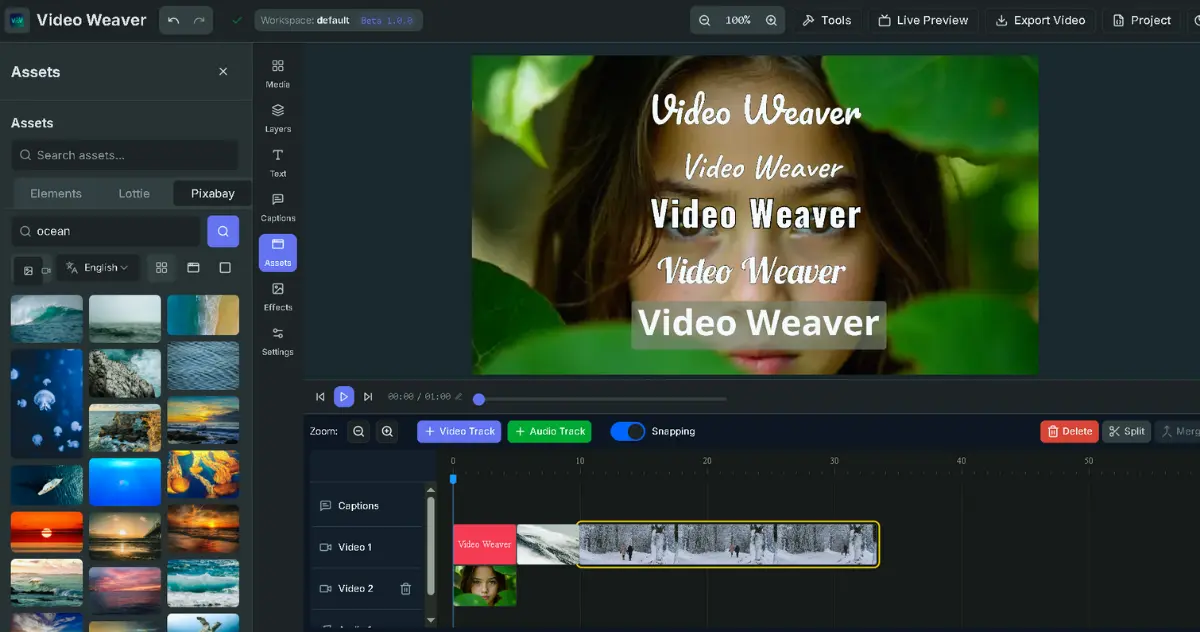
videoweaver.app
Video Weaver: Professional video editing directly in your browser. No downloads required.
Learn More
DMflow.chat
DMflow.chat: Your intelligent AI partner for exceptional customer engagement.
Learn MoreDMflow.chat
Discover DMflow.chat and unlock the new era of AI-powered customer service.
Learn Morevideoweaver.app
Video Weaver: Professional video editing directly in your browser. No downloads required.
Learn MoreDMflow.chat
DMflow.chat: Your intelligent AI partner for exceptional customer engagement.
Learn More