

Kimi K3: The 2.8 Trillion Parameter Open-Source Model Is Here – What Does It Mean for Autonomous Agents?
The release of Kimi K3 brings open-source models to the 3T (3 trillion) parameter threshold for the first time. Let’s break down its architectural design, inference costs, and the hardware considerations enterprise teams must face when deploying this “goliath” of an open-source model.
AI has long moved past the “ask and answer” chatbot phase. The current technological focus lies in autonomous agents—systems that can break down complex goals, plan steps, and invoke APIs and tools to complete tasks.
At this critical juncture, Moonshot AI has launched Kimi K3: Open Frontier Intelligence. With 2.8 trillion parameters, it is the largest open-source model to date. It doesn’t just increase in scale; it attempts to solve the engineering pain points of deploying agents at the architectural level.
MoE Structure and 1 Million Token Context
To make 2.8 trillion parameters function, traditional dense model approaches simply won’t work. Kimi K3 adopts a Massive Mixture-of-Experts (MoE) architecture. Out of 896 experts, only 16 are activated for a single computation. This extreme sparse routing design expands the model’s knowledge base while avoiding explosive inference compute costs, improving overall scaling efficiency by approximately 2.5x compared to the previous generation.
For long-text handling, K3 combines Kimi Delta Attention (KDA) with Attention Residuals (AttnRes) technology. This allows it to maintain a 1 million token context window while smoothly passing information across超-long sequences and deep networks. Whether processing an entire codebase or dozens of complex contracts, retrieval accuracy remains robust.
Furthermore, K3 utilizes a native multimodal design. Instead of attaching independent visual encoders, it projects text, static images, and dynamic video into a unified hidden space for joint processing.
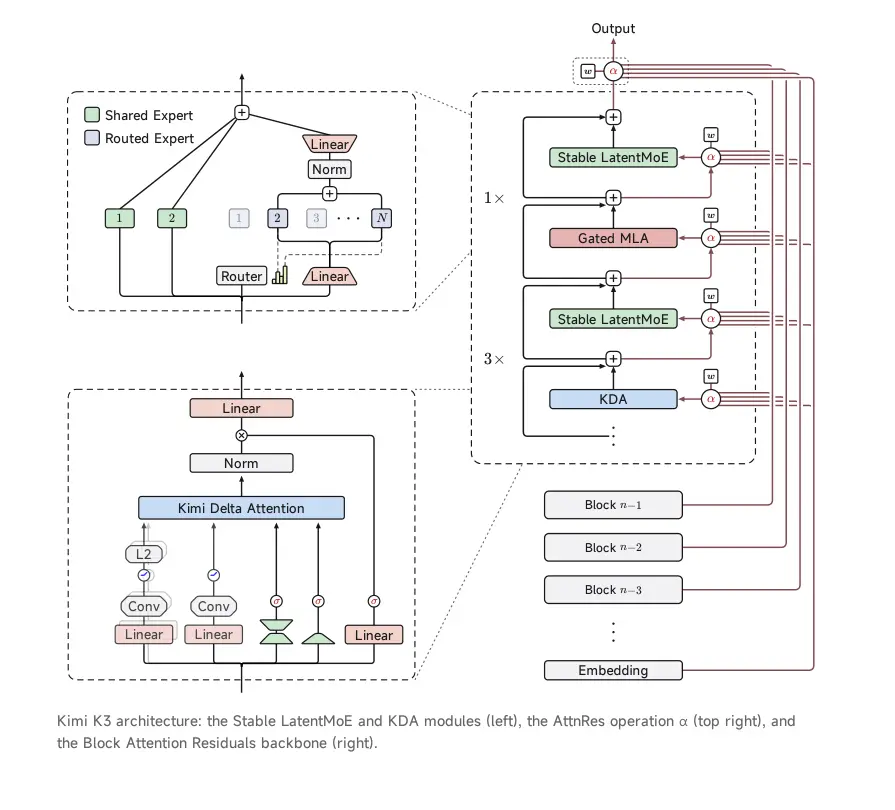 Image source: https://www.kimi.com/blog/kimi-k3
True High-Level Engineering Capability: From Building Compilers to Designing Chips
The most daunting aspect of Kimi K3 isn’t just its ability to write simple Python; it’s its capability to “re-invent the wheel” from the ground up.
In long-range autonomous R&D, official technical blogs mentioned that K3, during a 48-hour autonomous run, used open-source EDA tools and a 45nm process to design, optimize, and verify a miniature AI chip. This chip achieved a simulation decoding throughput of up to 8,700 tokens/s, proving its capability to handle multi-step, cross-tool engineering tasks.
Moreover, it developed from scratch a GPU compiler named MiniTriton. This compiler features its own IR layer and PTX code generation pipeline, with performance in some workloads surpassing mainstream industry compilers like Triton, while stably supporting end-to-end training for nanoGPT.
Scientific Automation and “True” Visual Loops
The native multimodal design makes Kimi K3 right at home in scientific research and visual tasks.
In an astrophysics test, K3 read over 20 papers, implemented numerical pipelines, evaluated over 300 equations of state, and wrote over 3,000 lines of code in about two hours, reproducing “I-Love-Q relation” research. This would typically take human scientists one to two weeks.
In visual development, it can achieve a true “vision in the loop.” It can write 3D game code using WebGPU while simultaneously “looking” at screen captures to correct errors, ultimately generating an open-world game featuring dynamic weather and 3D models.
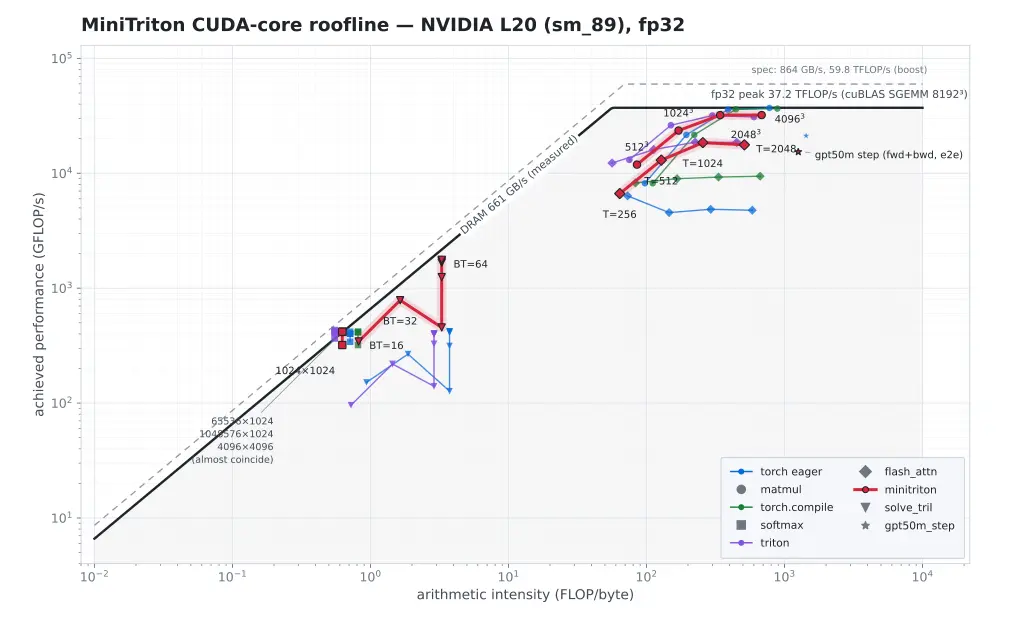 Image source: https://www.kimi.com/blog/kimi-k3
Open-Source Deployment and Extreme API Costs
For most enterprises, 2.8 trillion parameters sounds like a bottomless pit for VRAM. To support this mammoth, the officially recommended deployment environment consists of supernode configurations equipped with 64 or more accelerators.
However, for direct API usage, Kimi’s pricing puts immense pressure on competitors. Thanks to KDA caching technology and the Mooncake distributed inference architecture, its Cache Hit rate exceeds 90%. This brings the cached input price down to just $0.30 USD per million tokens (with a miss price of $3.00 and output of $15.00).
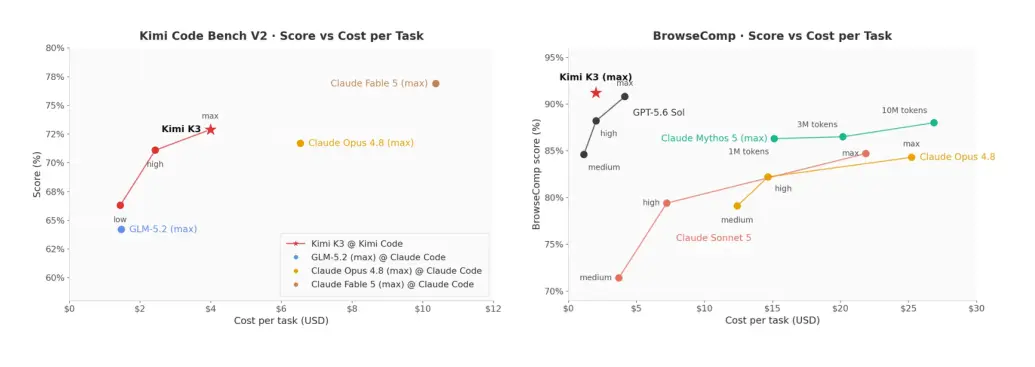 Image source: https://www.kimi.com/blog/kimi-k3
The launch of Kimi K3 proves that open-source models still have massive room for expansion in scale. Through extreme sparse MoE architecture and ultra-high cache hit rates, this 2.8T goliath hasn’t become an unusable lab toy. For developers and enterprises currently building complex agents, it undoubtedly provides a highly competitive new option for both local deployment and API consumption.
Q&A
Q1: 2.8 trillion parameters sounds astonishing. Does this mean average developers or SMEs simply “cannot afford” it? A: If you are talking about “local private deployment,” the barrier is indeed very high; the official recommendation requires supernodes with 64+ accelerators to support it. However, for average developers and startup teams, the real windfall is in API calls. Benefiting from KDA caching technology and distributed inference architecture, K3 boasts a cache hit rate of over 90% in code tasks, lowering cached input costs to just $0.30 USD per million tokens. This means you can drive a 3T-level advanced autonomous agent at an extremely competitive cost.
Q2: What is the advantage of the “native multimodal” design with no external visual encoder mentioned in the article in practical applications? A: AI vision in the past was largely “stitched together”—first using independent visual modules to “translate” images into features, and then handing them to a language model, easily losing details in the process. Kimi K3 projects text, images, and video into the same unified hidden space for joint processing, giving it true “vision in the loop” capability. For example, when developing 3D games, it can function like a human engineer, looking at rendered results to directly debug and correct them, rather than relying solely on terminal text errors.
Q3: It can design chips in 48 hours and even write a compiler from scratch—does this mean it can replace senior engineers? A: Currently, these cases are primarily shocking “Proof of Concepts (PoC).” For instance, the chip designed in 48 hours was a micro-chip prototype based on a 45nm process; while the MiniTriton compiler surpasses mainstream tools in specific workloads, there is still a distance before it replaces industrial-grade infrastructure. The greatest significance of these achievements is: it proves AI has crossed the “writing a single Python script” phase and formally possesses the terrifying strength to handle “multi-step, cross-tool, long-cycle” low-level software and hardware engineering.
Q4: If I want to immediately introduce K3 to develop AI Agents, are there any restrictions I need to pay special attention to? A: According to the official technical report, K3 is designed to be very proactive in its behavioral design to successfully handle difficult long-cycle tasks. This sometimes leads to “excessive proactiveness”—when encountering ambiguous instructions or minor errors, it might automatically make decisions for the user and continue executing. Therefore, when deploying K3 Agents, it is strongly recommended that developers set strict behavioral boundaries in the System Prompt to ensure its improvisation does not deviate from the original goal.