

Explore Chatterbox Multilingual, the open-source TTS (Text-to-Speech) model from Resemble AI. Learn how it empowers developers and creators with real-time voice cloning, emotion control, and support for 23 languages, challenging industry giants like ElevenLabs.
Have you ever wondered what it would be like if video narrations, game character voices, or virtual assistants in apps could have real human emotions and nuanced tones? In the past, achieving high-quality, multilingual voice generation often required significant time and expensive licensing fees. But now, an open-source project called Chatterbox Multilingual is quietly changing everything.
Introduced by Resemble AI, Chatterbox Multilingual is a production-grade, open-source text-to-speech (TTS) model that is not only completely free but also directly challenges many of the top paid tools on the market in terms of functionality.
Not Just “Speaking,” but “Conversing with Emotion”
Traditional TTS systems often sound stiff and robotic, like a machine reading a script word for word. But Chatterbox Multilingual is completely different. Its goal is to generate expressive, incredibly natural-sounding speech. Imagine being able to change the voice from a flat statement to a dramatic shout with a simple parameter. This is the unique feature of Chatterbox—emotion and tone intensity control.
This feature is a godsend for content creators. Whether you’re creating engaging YouTube videos, designing immersive games, or developing interactive applications, sound can become a powerful medium for conveying emotion.
Zero-Shot Voice Cloning: Clone Any Voice in Seconds
Even more impressive is its “Zero-Shot Voice Cloning” technology. What does this mean? Simply put, you only need to provide a short reference audio clip of a few seconds, and Chatterbox can instantly replicate the timbre, intonation, and style of that voice and use it to say any text you want.
This relies on a powerful machine learning model that doesn’t just memorize but learns to analyze and capture the unique characteristics of a voice, such as pitch, rhythm, and emotional features. The barrier to entry for this technology is extremely low; you can create a unique, custom voice for your project without any professional training.
Breaking Down Language Barriers: One Model, 23 Languages
The name Chatterbox Multilingual already highlights one of its core strengths: multilingual support. It works out of the box, supporting 23 languages worldwide, from major languages like Chinese, English, and Spanish to Arabic, Japanese, and even Swahili.
The language list includes:
- Arabic (ar)
- Danish (da)
- German (de)
- Greek (el)
- English (en)
- Spanish (es)
- Finnish (fi)
- French (fr)
- Hebrew (he)
- Hindi (hi)
- Italian (it)
- Japanese (ja)
- Korean (ko)
- Malay (ms)
- Dutch (nl)
- Norwegian (no)
- Polish (pl)
- Portuguese (pt)
- Russian (ru)
- Swedish (sv)
- Swahili (sw)
- Turkish (tr)
- Chinese (zh)
It’s worth noting that, according to the official documentation, the performance is currently most stable for English (en), Spanish (es), Italian (it), Portuguese (pt), French (fr), German (de), and Hindi (hi).
Why Open Source? The Perfect Combination of Freedom and Quality
Chatterbox Multilingual is licensed under the MIT license, which means developers and creators can use it completely free of charge in personal and even commercial projects, offering a high degree of freedom. This stands in stark contrast to many closed, expensive commercial TTS services (like ElevenLabs).
Interestingly, in several blind tests, many listeners even preferred the voice generated by Chatterbox, considering it superior in emotional expression and naturalness. This proves that open-source projects can not only win in terms of freedom but also compete with industry leaders in quality.
Responsible AI: Built-in PerTh Watermarking Technology
While enjoying the convenience brought by AI, we must also face its potential risks of misuse. Resemble AI has clearly considered this. Every piece of audio generated by Chatterbox has the PerTh (Perceptual Threshold) watermarking technology enabled by default.
This is a deep neural network watermark based on psychoacoustic principles, which embeds data into the audio in a way that is imperceptible to the human ear. This watermark is very robust. Even if the audio is compressed, edited, or converted to a different format, it can still be detected, providing a safeguard for tracking and verifying the source of AI-generated content.
Who Is It For? Developers, Creators, and Innovative Teams
Whether you are:
- A developer: looking to add more human-like voice interaction to your AI agents, voice assistants, or applications.
- A game designer: hoping to give your game characters vivid, emotional voice-overs.
- A video creator: needing high-quality, multilingual narration for your content.
- Anyone pursuing innovation: wanting to explore the infinite possibilities of voice AI.
Chatterbox Multilingual offers a powerful, flexible, and completely free solution. It is not just a tool, but a catalyst for creativity, breaking down language and technology barriers.
Frequently Asked Questions (FAQ)
Q1: What is the difference between Chatterbox Multilingual and ElevenLabs on the market?
Chatterbox is an open-source model under the MIT license, completely free, giving developers great freedom and control. ElevenLabs is a commercial cloud platform known for its realistic voices and easy-to-use interface, but it requires payment. In terms of functionality, Chatterbox emphasizes adjustable emotional control, while ElevenLabs focuses more on automated tone interpretation.
Q2: What is “Zero-Shot Voice Cloning”? Do I need to prepare a lot of recordings?
Not at all. Zero-shot voice cloning is an advanced technology that requires only a few seconds of a target voice sample for the AI to learn its timbre characteristics and use them to generate new speech content, without requiring additional training for that specific voice.
Q3: Which languages does Chatterbox support?
It supports 23 languages, including Chinese, English, Japanese, Korean, French, German, Spanish, Arabic, and more.
Q4: Can the voice generated by Chatterbox be used for commercial projects?
Yes. Chatterbox is licensed under the MIT license, which is a very permissive open-source license that allows users to freely use, modify, and distribute it in commercial projects.
Q5: What is the PerTh watermark? Does it affect the sound quality?
PerTh is a neural network watermark embedded in the audio that is imperceptible to the human ear. Its purpose is to trace the source of AI-generated content to prevent misuse of the technology. Because it is designed based on psychoacoustic principles, it does not affect the perceived sound quality.
DMflow.chat
DMflow.chat: Your intelligent AI partner for exceptional customer engagement.
Learn More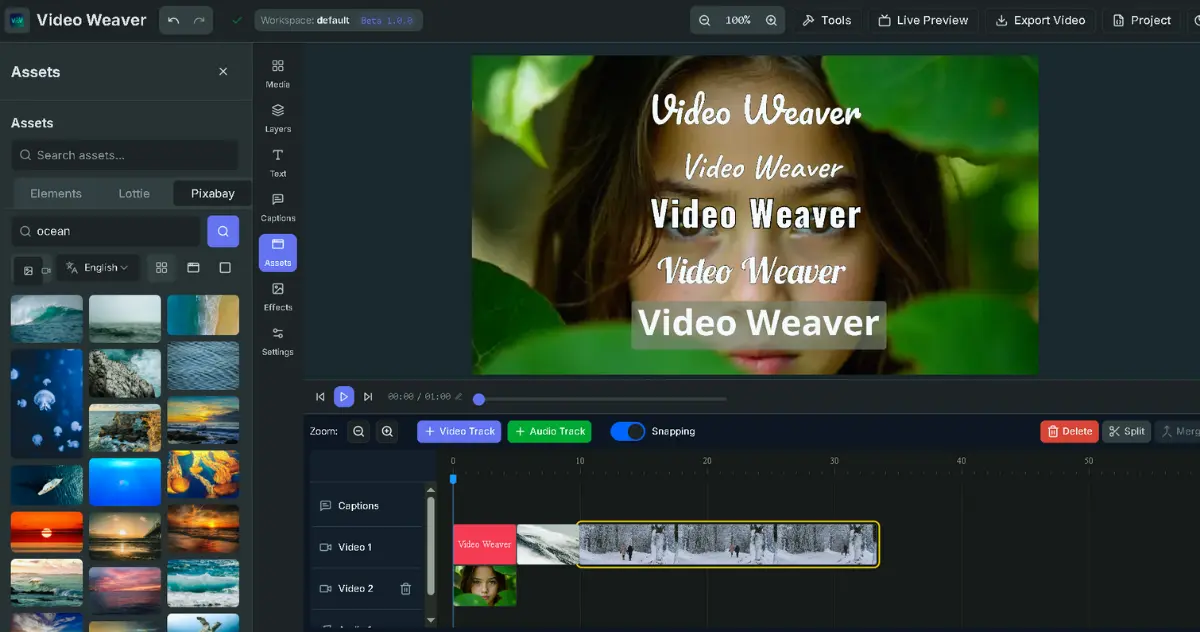
videoweaver.app
Video Weaver: Professional video editing directly in your browser. No downloads required.
Learn More
DMflow.chat
Discover DMflow.chat and unlock the new era of AI-powered customer service.
Learn MoreDMflow.chat
DMflow.chat: Your intelligent AI partner for exceptional customer engagement.
Learn Morevideoweaver.app
Video Weaver: Professional video editing directly in your browser. No downloads required.
Learn MoreDMflow.chat
Discover DMflow.chat and unlock the new era of AI-powered customer service.
Learn More