

November 6, 2025, sees a surge in the AI field. OpenAI celebrates a milestone of one million enterprise clients, Google continues to strengthen its Gemini ecosystem, and the historic reconciliation between music industry giant UMG and AI startup Udio could fundamentally change the future rules of the game for AI-generated content. This article will quickly bring you up to speed on today’s most noteworthy AI developments.
OpenAI’s New Trick: ChatGPT Queries Can Now “Cut in Line”
Have you ever had this experience? You give ChatGPT a complex instruction, watch it work hard for a long time, and then suddenly realize: “Oh no, I forgot to mention something important!” As a result, you can only watch it generate an unsatisfactory answer and then start all over again.
The good news is that such regrettable moments may become a thing of the past. OpenAI announced the launch of a query pause feature for ChatGPT. Now, when you find that a running query needs adjustment, you can directly interrupt it, add new background information or modify requirements, without having to start from scratch.
This feature sounds simple, but for users who need in-depth research or use powerful models like GPT-5 Pro, it’s simply a huge blessing. The model will instantly adjust its response direction based on your “cut-in” new instructions, making the entire interaction process smoother and more efficient. You just need to click “Update” in the sidebar to easily add details or clarify requirements.
Google’s Continuous Evolution: Gemini API Structured Outputs Become More Obedient
Google announced the enhancement of the Gemini API’s Structured Outputs feature. This update expands support for OpenAPI and better adheres to the order of properties defined by developers in the schema.
What does this mean? Simply put, Gemini can now respond more precisely according to your set “template.” This is crucial for tasks such as data extraction and automatic database filling. Even better, it also paves the way for complex multi-agent systems—the standardized output of one agent can directly become the standardized input of the next agent, eliminating the need for tedious format conversions in between, making collaboration seamless.
Gemini CLI Toolchain Update, Developer Ecosystem Expands Further
Beyond just the API, Google is also building more convenient command-line tools for developers. The latest Gemini CLI v0.12.0 update brings a series of exciting features.
The most eye-catching additions are three new partner extensions:
- Hugging Face: Allows developers to directly access the vast resources of the Hugging Face Hub from the command line.
- Monday.com: Can analyze your project progress and update task boards using natural language.
- Data Commons: Can query massive public datasets, providing more solid data support for your AI responses.
In addition, this update also introduces a “smart model routing” feature. The Gemini CLI will automatically determine the complexity of your task; simple queries will be handled by the lightweight Flash model, while complex analysis or creative tasks will utilize the more powerful Pro model. This not only ensures optimal results but also intelligently saves your API quota. Of course, if you want to specify a model yourself, you can always switch manually.
Perplexity’s Ambition: Enabling Trillion-Parameter Models on AWS
When model parameters reach the trillion level, how to run them efficiently becomes a major challenge. The GPU memory of a single node simply cannot handle it, and multi-node deployment is necessary.
Renowned AI company Perplexity released their latest research results: a set of MoE (Mixture-of-Experts) kernels that can efficiently run trillion-parameter models on AWS EFA (Elastic Fabric Adapter).
This technological breakthrough solves the latency problem when performing expert parallel computing across multiple nodes, and its performance even surpasses existing top solutions. Simply put, Perplexity has found the key to deploying ultra-large-scale models on cloud platforms, making it possible for these “behemoth” models, which previously only existed in top laboratories, to be commercially applied.
Cursor’s New Breakthrough: Semantic Search Helps AI Agents Understand Your Code Better
There are more and more AI coding tools, but it is still very difficult to make AI truly understand a large and complex codebase and make precise modifications.
AI code editor Cursor published an article explaining how they significantly improved the accuracy of their Agent through “semantic search”. Traditional grep commands can only do text matching, but Cursor trained its own embedding model, allowing the Agent to understand the “intent” of the code using natural language.
For example, you can directly ask: “Where do we handle authentication?” The Agent can then precisely locate the relevant code snippets. According to their A/B tests, after introducing semantic search, the average accuracy of AI Agent’s Q&A increased by 12.5%, and in large codebases, the code retention rate (i.e., the proportion of AI-written code retained by developers) even increased by 2.6%. This proves that deep understanding is an indispensable step for AI to become a true development partner.
OpenAI’s Great Commercial Success: Reaching the Milestone of One Million Enterprise Clients
From a non-profit research institution to an AI commercial giant today, OpenAI’s growth rate is astonishing. OpenAI proudly announced that they have reached the milestone of one million enterprise paying clients, becoming one of the fastest-growing commercial platforms in history.
This number covers all organizations that pay to use OpenAI’s technology, whether through ChatGPT for Work or directly using its developer platform. From financial services, healthcare to retail, industry giants such as Amgen, Cisco, and Morgan Stanley have joined its client base.
With the surge in enterprise clients, OpenAI has also launched more tools designed for enterprises, such as AgentKit and “Company Knowledge Base,” to help enterprises more easily integrate AI into internal operations and team workflows, achieving a transformation from individual use to company-wide impact.
Music Industry Earthquake: The Power Play Behind the UMG-Udio Agreement
Finally, let’s turn our attention to a piece of news that could have a profound impact on the entire generative AI field.
Universal Music Group (UMG) and AI music generation platform Udio have reached a historic agreement. This is not just about resolving a major copyright lawsuit, but a fundamental reshaping of the future structure of the AI music market. This agreement, especially its core “no download” policy, symbolizes the end of the “wild west” era of AI music.
Core Analysis: The True Purpose of “No Download”
The starting point of this dramatic shift was the copyright lawsuit filed by UMG and other record companies against Udio, accusing it of using a large amount of copyrighted music to train its models. However, UMG’s goal was clearly not to destroy Udio, but to bring it under its control.
The core mechanism of the agreement is Udio’s immediate implementation of a “no download” policy. This policy not only prohibits downloading MP3s, but more crucially, prohibits downloading “stems” files. For music producers, being unable to export individual instrument tracks means that Udio has been downgraded from a professional creative tool to an amateur music toy.
The strategic intent of this move is very clear: to create a “walled garden.” All AI-generated music is permanently trapped within the Udio platform and cannot be exported to platforms like Spotify, YouTube, etc., to compete with UMG’s official music library, thereby curbing the threat of market erosion.
Gains and Losses for Both Sides: Who are the Winners? Who are the Losers?
- For UMG: This is a huge strategic victory. They not only eliminated legal threats but also transformed AI from a competitor into a new type of consumption model that is under their control, traceable, and monetizable. In the future, every time a fan generates “Taylor Swift style” music on Udio, it could bring revenue to UMG and Taylor Swift.
- For music producers (users): This is undoubtedly disastrous. They lost ownership and control of their creations overnight. Udio’s value has changed from a tool that can generate “assets” (song files) to an “experience” that can only provide temporary entertainment. This also forces professional creators to turn to platforms like AIVA and Suno Pro, which still offer ownership and commercial rights.
- For the AI industry: Udio’s “defection” leaves its former ally Suno extremely isolated legally. Udio has publicly admitted that its unauthorized training methods have legal problems, which makes Suno’s “fair use” defense vulnerable. UMG can now concentrate all its firepower to seek a complete victory against Suno in court, setting a permanent legal precedent for the entire AI industry: “License or perish.”
This agreement has set new rules for the AI music market. In the future, AI platforms will face a tough choice: either, like Udio, cooperate with copyright holders and become a closed but legal “walled garden”; or, like AIVA, focus on serving niche markets that require ownership and professional tools. The “Suno route,” which attempts to operate in a gray area, is becoming less strategically viable.

DMflow.chat
Discover DMflow.chat and unlock the new era of AI-powered customer service.
Learn More
DMflow.chat
DMflow.chat: Your intelligent AI partner for exceptional customer engagement.
Learn More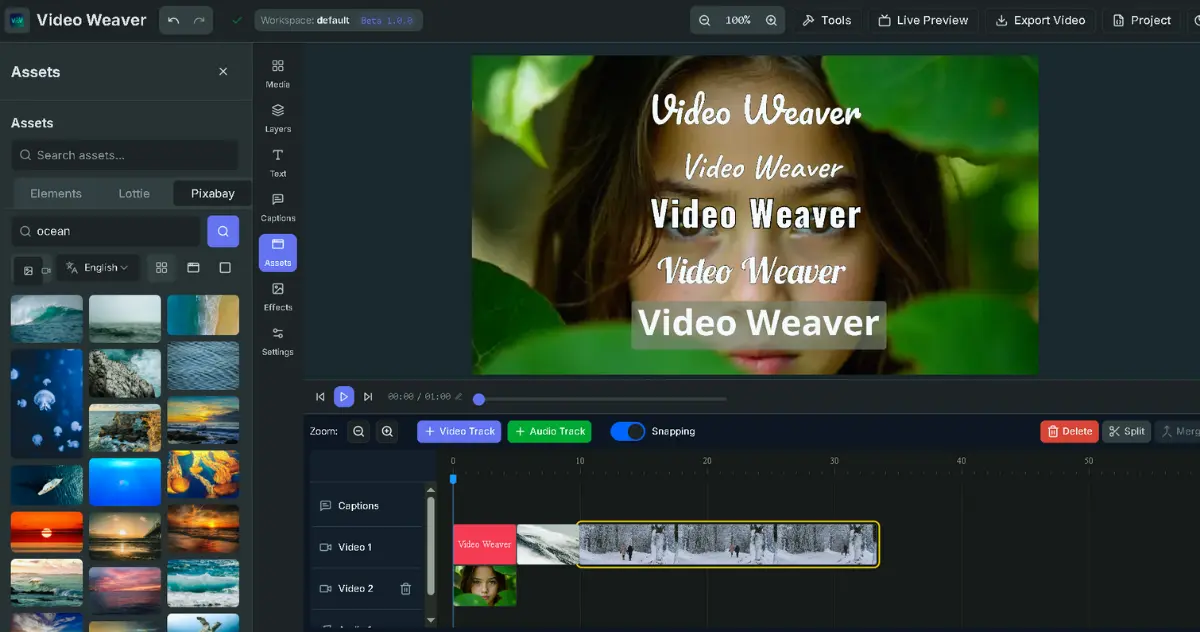
videoweaver.app
Video Weaver: Professional video editing directly in your browser. No downloads required.
Learn MoreDMflow.chat
Discover DMflow.chat and unlock the new era of AI-powered customer service.
Learn MoreDMflow.chat
DMflow.chat: Your intelligent AI partner for exceptional customer engagement.
Learn Morevideoweaver.app
Video Weaver: Professional video editing directly in your browser. No downloads required.
Learn More