

To be honest, watching new updates constantly pop up in the tech world can be truly dizzying. Did you know? While everyone is still adapting to various new tools, the rules of the game for the entire industry have been rewritten once again. From global alliances of open-source base models to AI directly taking over PC desktops, and even revolutionary breakthroughs in gaming graphics, various technologies are intertwining at a breathtaking pace.
Here is a summary of the most influential recent technological advancements to help you thoroughly understand these new tools that will completely transform daily work and entertainment.
Open Source Power Unites: The Heavyweight Debut of the Nemotron Alliance
NVIDIA recently announced the formation of the Nemotron Alliance, which is undoubtedly the most eye-catching highlight recently. This is a global collaborative project bringing together top laboratories. Participants have decided to share their respective expertise, computing resources, and data to jointly advance the development of open-source base models.
The birth of this alliance is of great significance. Major companies that used to work in silos are now choosing to cooperate. Mistral AI announced it has become a founding member, contributing its expertise in model architecture and multimodal capabilities. Meanwhile, Perplexity has also joined the ranks, along with Black Forest Labs, Cursor, LangChain, Reflection AI, Sarvam, and Thinking Machines Lab. The goal is to turn this new set of models, trained on NVIDIA DGX Cloud, into a powerful foundation that everyone can use flexibly. This means future technological development will be more transparent and accessible, allowing anyone to build dedicated applications.
Versatile Models: No More Need to Choose
While participating in the alliance, Mistral has not slowed down. They just launched Mistral Small 4, which can be described as a masterpiece. In the past, when handling different tasks, one had to switch between reasoning, visual analysis, or code generation models. Now, this new model packages Mistral’s reasoning capabilities, Devstral’s agent coding features, and Mistral Small’s instruction processing (instruct) all together, while also natively supporting powerful multimodal visual analysis.
Users can use new parameter settings to decide at any time whether the model should give a lightweight and fast response or perform complex step-by-step reasoning. For developers, a dedicated collection for Mistral Small 4 is already available on Hugging Face for testing.
However, bottlenecks in software development often occur during manual code reviews. To address this pain point, Mistral simultaneously launched Leanstral, an open-source code agent specifically designed for Lean 4. This tool can precisely handle complex mathematical verification and software specification testing. Developers now only need to tell the AI the desired result, and Leanstral will be responsible for generating and perfectly proving the correctness of the logic. For those who want to try it out, you can download the open-source weight models of Leanstral from Hugging Face or test it directly via their provided labs-leanstral-2603 API endpoint.
When AI Directly Takes Over Personal Devices
Cloud tools are convenient, but many people’s core work files still reside on local computers. To bridge this gap, Manus launched a new desktop integration feature, directly bringing AI agents into the user’s local environment.
Through terminal commands, Manus can read, analyze, and even edit local files. Imagine a flower shop owner whose computer is filled with thousands of uncategorized photos. By just giving a command like “help organize flower shop photos,” the system will automatically scan the content and create categorized folders. It sounds like magic, doesn’t it?
Some might wonder: doesn’t letting AI freely control a personal computer raise security concerns? In fact, the system is designed with a very strict authorization mechanism. Every terminal command requires explicit approval before execution. The user remains the commander issuing orders, while the AI is just a dutiful executor.
On the other hand, competition in the mobile space has also entered a fever pitch. Perplexity announced it is bringing its most powerful Computer platform to Android. This tool is essentially an all-purpose digital employee. It integrates over 19 top models and automatically assigns work based on the task. It calls upon Claude Opus 4.6 when powerful logical reasoning is needed, sends Gemini for complex research, and even uses Veo 3.1 for video generation. It features persistent memory and can handle multiple tasks in parallel, requiring almost no close human supervision.
Many might ask why such a digital assistant has a monthly subscription fee as high as $200. The reason is that it is tailored for high-end professionals and developers. These users need absolute autonomy in project execution. By paying the fee, they can experience an efficient workflow comparable to an entire team.
A New Milestone in Gaming Graphics: A Visual Experience Explosion
Having discussed work and development, let’s talk about the bombshell in the entertainment sector. NVIDIA officially released DLSS 5, a technology hailed by Jensen Huang as the GPT moment for graphics computing.
Previously, game developers pursuing realistic lighting were often limited by hardware computing performance. Now, DLSS 5 introduces a real-time neural rendering model that can directly inject photo-realistic lighting and textures into game pixels. The model analyzes the color and motion vectors of a single frame, understanding various elements in the scene—such as a character’s hair, translucent skin, or environmental light refraction—and then generates stunning visual effects in real-time.
This means Hollywood movie-level special effects can finally be presented smoothly and in real-time in everyday games. Well-known blockbusters like Starfield, Hogwarts Legacy, and Resident Evil: Requiem are already prepared for this technology. Future gaming graphics will be so realistic that it will be difficult to distinguish between reality and fiction, and the visual feast will reach unprecedented levels.

DMflow.chat
Discover DMflow.chat and unlock the new era of AI-powered customer service.
Learn More
DMflow.chat
DMflow.chat: Your intelligent AI partner for exceptional customer engagement.
Learn More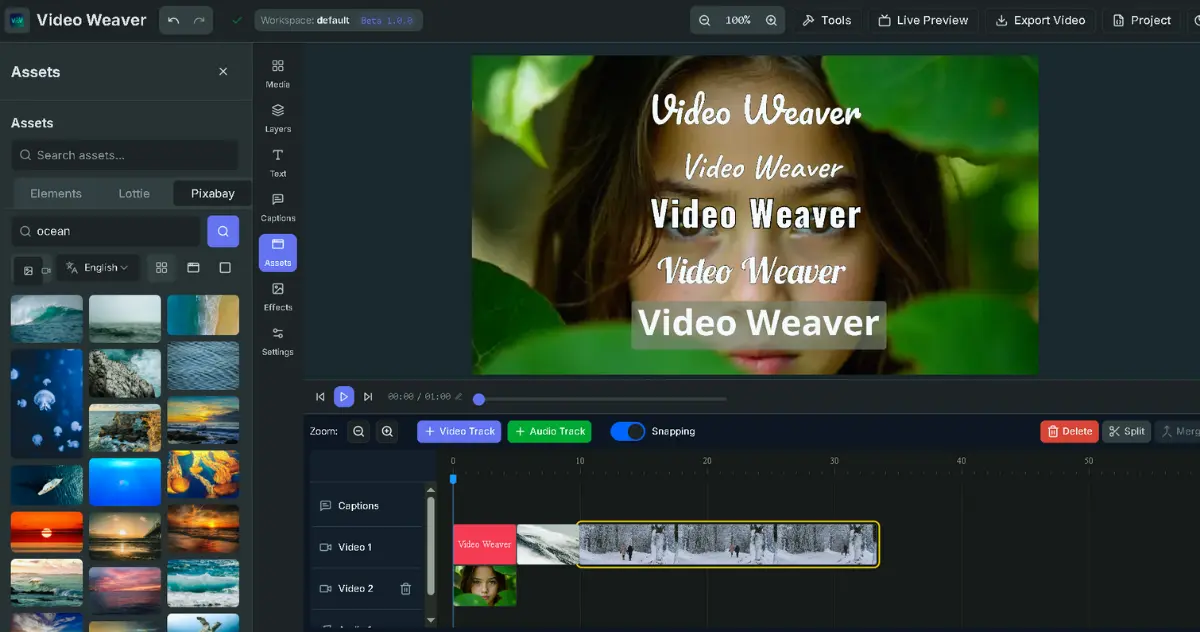
videoweaver.app
Video Weaver: Professional video editing directly in your browser. No downloads required.
Learn MoreDMflow.chat
Discover DMflow.chat and unlock the new era of AI-powered customer service.
Learn MoreDMflow.chat
DMflow.chat: Your intelligent AI partner for exceptional customer engagement.
Learn Morevideoweaver.app
Video Weaver: Professional video editing directly in your browser. No downloads required.
Learn More