

Catch Up on Daily AI News: Meta Unveils Multimodal Model Muse Spark, Anthropic Reshapes Agent Architecture
The world of technology is evolving rapidly, with innovative applications emerging constantly. Have you ever wondered what a future personal super-intelligence might look like? Today’s highlights range from revolutionary large language model architectures to breakthroughs in edge computing vision technology, and comprehensive upgrades to everyday productivity tools.
Whether you are a developer or a tech enthusiast, staying informed about these advancements can be incredibly beneficial. Please read on for today’s curated selection of significant progress.
Meta Introduces Muse Spark, Moving Toward Personal Super-Intelligence
Building a super-assistant that truly understands you has long been a goal for many tech giants. Meta has announced the Muse Spark model, marking a pivotal step in their AI journey.
This model possesses native multimodal reasoning capabilities. It not only supports tool use but also features visual Chain-of-Thought (CoT) and multi-agent collaboration. This means it can handle complex tasks more intelligently. Honestly, such a comprehensive upgrade is truly impressive.
To support future scalability, the development team has completely overhauled the entire technical architecture. Significant resources have been invested from front-end research and model training to back-end infrastructure. This all-encompassing investment has led to a noticeable improvement in computational efficiency.
What Makes the Unique Contemplating Mode Special?
Many readers might wonder how Muse Spark handles extremely difficult tasks. The answer lies in the new Contemplating mode. This mode coordinates multiple agents to think in parallel, allowing it to compete with the top reasoning models on the market.
In terms of benchmarks, it performs brilliantly in highly challenging evaluations. Regarding safety, the development team has implemented rigorous safeguards. The model demonstrates strong refusal mechanisms for high-risk areas like biological weapons, ensuring that the technology remains within safe boundaries.
Anthropic Redefines Architecture: Managed Agents Separate the Brain from the Hands
When it comes to the underlying logic of agents, Anthropic has proposed an intriguing engineering perspective. As models become smarter, old architectures have become a limitation. Consequently, they have launched the new Managed Agents service.
Readers can explore the specific details through this official documentation. The core concept of this update is clear: completely separate the “brain” from the “hands.”
What are the “brain” and the “hands”? Here, the brain refers to the Claude model and its communication interface, while the hands are the sandbox environment and tools that execute actions. Previously, these components were all bundled in the same container. If the container crashed, all operational logs would vanish with it.
Why Separate the Brain and the Hands?
You can think of the old system as a “pet” that requires meticulous care. If the pet gets sick, the entire task stops. Now, Anthropic has virtualized these components, turning them into “cattle” that can be replaced at any time.
This brings two massive benefits. First, the system becomes exceptionally stable. Even if an execution environment crashes, the system can quickly restart a new one to take over the work. Second, security is significantly enhanced. Untrusted code is no longer in the same space as credentials, fundamentally blocking potential security risks.
Liquid AI Focuses on Edge Computing: LFM2.5-VL-450M Vision-Language Model Debuts
Did you know that not all AI needs to rely on massive cloud servers? Sometimes, placing computational power directly on end devices can solve latency and privacy issues.
This is the inspiration behind Liquid AI’s release of the LFM2.5-VL-450M vision-language model. It is a model specifically designed for edge devices. Even with limited hardware resources, it still delivers powerful performance.
This model can process a 512x512 image in just 242 milliseconds. This means it is fully capable of handling real-time video streams at 4 frames per second. Developers can now go to Hugging Face to download the model weights for testing.
What Is the Biggest Breakthrough for Edge Computing Models?
Traditional vision systems usually require multiple steps: detecting objects, classifying them, and then applying additional logic for judgment. This process is both time-consuming and resource-intensive.
LFM2.5-VL-450M changes this. It can complete object localization, contextual analysis, and return structured data all in a single computation. Furthermore, it supports visual understanding in up to nine languages. Whether installed on smartphones or industrial equipment, it demonstrates high practical value.
Gemini Integrates NotebookLM to Create Organized Project Workspaces
Now, let’s look at the latest updates for productivity tools. When you are working on several projects simultaneously, managing scattered notes and conversation logs can be exhausting.
Google noticed this pain point and has officially launched the Notebooks feature in Gemini. It’s like having an external hard drive for your brain.
You can organize specific conversations, uploaded documents, and related data into the same notebook. Best of all, this content stays synchronized with NotebookLM. This means you can use NotebookLM’s special features to organize your Gemini conversation history. This feature will first be available to specific subscribers and will be rolled out to more users in the coming weeks.
Google Colab Launches Learn Mode: Your Personal Coding Tutor Is Online
For developers, hitting a roadblock while coding is common. Many people have a habit of letting AI generate a snippet of code and then just pasting it. But honestly, you often don’t learn the core concepts that way.
To improve this learning model, Google Colab has introduced the new Learn Mode and custom instructions. This update completely changes the way we interact with AI.
When you enable Learn Mode, the AI is no longer just coldly spitting out code. It becomes a highly patient tutor. Through step-by-step guidance, it explains complex concepts to you. Combined with custom instructions that can be saved at the notebook level, you can ask the AI to always use a specific coding style, making the learning experience more personalized.
AI-Powered Google Finance Expands to Over 100 Countries
Finally, some news from the financial sector. Keeping up with real-time market trends is crucial for investors. Google Finance, integrated with AI technology, is expanding significantly worldwide, with coverage expected to reach over a hundred countries.
This upgrade brings many practical features. You can ask the AI complex market questions directly and receive detailed answers. New charting tools also make technical analysis more intuitive.
Even more exciting is that it provides real-time audio and synchronized transcripts for corporate earnings calls. Coupled with AI-generated summaries, anyone can easily grasp key information about a company’s operations. This truly brings great convenience to how financial information is accessed.
Q&A
Q1: How does the new “Contemplating mode” in Meta’s Muse Spark model specifically work? A: The core of Contemplating mode lies in its ability to coordinate multiple agents for parallel thinking simultaneously. This means when you pose a complex request (like planning a family trip), it can launch multiple sub-agents to work concurrently: one for drafting the itinerary, one for comparing different locations, and another for finding kid-friendly activities. This multi-agent collaboration allows Muse Spark to compete with the top reasoning models on the market, significantly improving the speed and quality of answers to complex problems.
Q2: What fatal flaw of the old architecture did Anthropic solve by separating the “brain” and the “hands” in Managed Agents? A: Previously, bundling the brain (model), hands (sandbox and tools), and conversation memory in the same container meant that if the container crashed, all operational logs disappeared, and engineers had to go in and fix it like caring for a “pet.” By separating the brain and hands, the execution environment becomes “cattle” that can be discarded and replaced at any time. Even if it crashes, the brain can quickly restart a new environment to take over. More importantly, this blocks security risks, ensuring that untrusted code executed in the sandbox cannot easily access authentication credentials.
Q3: What is the specific performance of Liquid AI’s LFM2.5-VL-450M model in “edge computing,” and where can it be applied? A: Its processing speed is extremely fast, taking only 242 milliseconds to process a 512x512 resolution image on an edge device (like Jetson Orin). This is sufficient for handling real-time video streams at 4 frames per second (4 FPS). This makes it ideal for scenarios with high requirements for computational resources, low latency, and privacy, such as wearable devices like smart glasses, car dash cams, warehouse automation (tracking forklifts and cargo), and shelf monitoring in retail.
Q4: How can Gemini’s newly launched Notebooks feature, synchronized with NotebookLM, change workflows? A: You can create dedicated notebooks in the Gemini sidebar to consolidate related conversations and documents (like PDFs). Because it syncs bi-directionally with NotebookLM, data you upload to one side can be used directly on the other. For example, a student can put class notes into a notebook, use NotebookLM features to generate videos or charts, and then open the Gemini App the next day to ask the AI to draft a thesis outline based on that same note data, achieving a powerful and seamless workflow.
Q5: What makes Google Colab’s Learn Mode special for people who want to learn programming? A: In the past, when developers encountered problems, AI would typically just throw out a large block of code for you to copy and paste, which wasn’t very helpful for learning core concepts. Learn Mode, however, acts as a “personal coding tutor.” It doesn’t give you the answer directly but instead uses “step-by-step guidance” to break down complex concepts and explain the underlying logic, helping you truly cultivate and develop your programming skills.
DMflow.chat
DMflow.chat: Your intelligent AI partner for exceptional customer engagement.
Learn More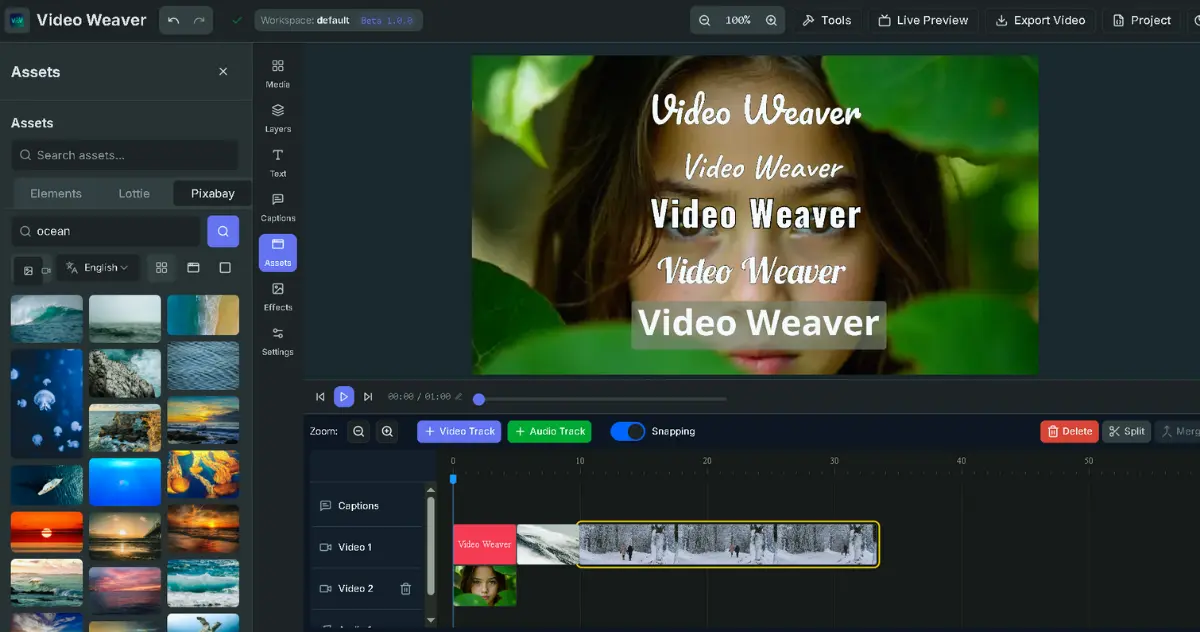
videoweaver.app
Video Weaver: Professional video editing directly in your browser. No downloads required.
Learn More
DMflow.chat
Discover DMflow.chat and unlock the new era of AI-powered customer service.
Learn MoreDMflow.chat
DMflow.chat: Your intelligent AI partner for exceptional customer engagement.
Learn Morevideoweaver.app
Video Weaver: Professional video editing directly in your browser. No downloads required.
Learn MoreDMflow.chat
Discover DMflow.chat and unlock the new era of AI-powered customer service.
Learn More