

Tech Trends: ChatGPT Visual Learning Guide and Fish Audio Voice Open Source News — Master the Latest in AI
The pace of technological development is often surprising, with new tools emerging daily to simplify our lives. To be honest, staying sharp in the face of vast and complex information is no easy feat. Today, we’ve summarized several high-profile tech advancements, covering educational tools, office productivity, social network strategies, and essential updates for developers on voice and code assistants. Let’s see how these technologies are quietly changing our daily routines.
Making Math and Science Less Abstract: ChatGPT’s Visual Interaction Magic
Many adults still find math and science concepts quite difficult to grasp. A Gallup survey shows that more than half of American adults struggle with math. Faced with dense formulas, it’s easy to feel intimidated. To address this pain point, ChatGPT has introduced a brand-new way to learn math and science visually and interactively.
This feature covers over 70 core math and science concepts. Users don’t just get text-based answers; they can also adjust variables directly on the interface. When variables change, charts and results update in real-time. This visual interaction design turns dry equations into tools for hands-on experimentation. Educators also believe that understanding the principles behind how things work is far more effective than rote memorization. This new feature is now available globally to all users on logged-in plans, making the learning process more vivid and engaging.
Saying Goodbye to the Blinking Cursor: Google Workspace’s New Productivity Assistant
Staring at a blank document or spreadsheet is a common struggle for many. However, Google Workspace has brought the latest Gemini updates, specifically designed to solve this problem. These features are first being rolled out to Google AI Ultra and Pro subscribers.
In Docs, Gemini can generate initial drafts directly from meeting notes and unify the tone of an entire article. If you have a favorite travel itinerary template, it can even automatically pull flight and hotel information from emails to fill it out. Sheets has also become smarter; by simply typing a short description, it can build a complete project list. While this might sound like it requires a lot of manual effort, the system actually fills in missing data automatically, saving significant time spent searching for information. Slides and Drive have also received upgrades, making presentation design and cross-file searching as natural as talking to a person.
Meta’s New Social Strategy: Recruiting the Moltbook Core Team
The evolution of social networks is always full of surprises. Meta recently recruited the core duo behind Moltbook, Matt Schlicht and Ben Parr. They will officially join the Meta Super Intelligence Lab led by Alexandr Wang.
Moltbook is a social network specifically designed for AI agents. It established a unique registration system that allows AI agents, with authorization from their human owners, to verify identities and communicate with each other. This technology is closely related to a previous project called OpenClaw. Through this recruitment, Meta is clearly exploring new models for how AI agents can assist both businesses and individuals. While existing Moltbook customers can continue using the platform for now, the future direction of system integration is worth keeping a close eye on.
A New Height in Voice Generation: Fish Audio Open-Sources S2 Model
Progress in voice generation technology is breathtaking. Fish Audio has officially open-sourced the S2 model, providing creators and developers with unprecedented control. S2 supports fine-grained inline controls, allowing users to add natural language tags directly within the text. For example, entering “whisper” or “professional broadcast tone” allows the model to accurately render the corresponding emotion and tone. This tool is not only available on the Fish Audio App, but its open-source version can also be obtained via the HuggingFace platform.
You might have some common questions about this technology. First, how does multi-speaker dialogue generation work? The system allows for processing multiple speakers in a single generation; you can switch seamlessly by simply specifying them with tags. Second, what audio tags and languages are supported? S2 doesn’t rely on fixed, predefined tags; instead, it accepts free-form natural language descriptions and supports over 80 languages, backed by tens of millions of hours of audio data. Finally, is it available via API? Yes, developers can use the SGLang Omni integration suite for production-grade streaming, enjoying a first-packet latency of only about 100 milliseconds. S2 has performed exceptionally well in various evaluations, including audio Turing tests. For research and non-commercial use, the open-source code has been published on GitHub for the community to explore for free.
The Hero Behind Integrating Multiple Formats: Gemini Embedding 2 Debuts
The complexity of data processing can often be daunting. Let’s explain how Gemini Embedding 2 solves this challenge. This is Google’s first native multimodal embedding model. It can map text, images, video, audio, and up to 6 pages of PDF documents all into the same vector space.
This means the system can natively understand interleaved input data. Developers can pass images and text simultaneously in a single request to capture subtle relationships between different media types. This model utilizes Matryoshka Representation Learning technology, offering flexible choices for output dimensions. It is currently available in public preview via the Gemini API and Vertex AI, meeting various development needs for retrieval-augmented generation and semantic search.
Ask Without Interruption: Claude Code Introduces Lightweight Commands
When coding, having your train of thought interrupted is one of the most frustrating things. Claude Code’s newly introduced /btw command is designed for exactly this. Users can use this command to open a “side-chat” while Claude is processing a long-running task.
It’s a very lightweight design. Both the question and answer are displayed in a closable floating window, without entering the main conversation history. It can read the full context of the current conversation, allowing users to confirm the name of a configuration file or a previous decision at any time. This command cannot access external tools or read new files. While this might seem like a limitation, it’s actually a benefit: because it only relies on the known context and reuses the prompt cache, the operation cost is extremely low and the response is very fast. With a simple press of the spacebar or Esc key, you can easily close the window and continue focusing on your development work.
DMflow.chat
Discover DMflow.chat and unlock the new era of AI-powered customer service.
Learn More
DMflow.chat
DMflow.chat: Your intelligent AI partner for exceptional customer engagement.
Learn More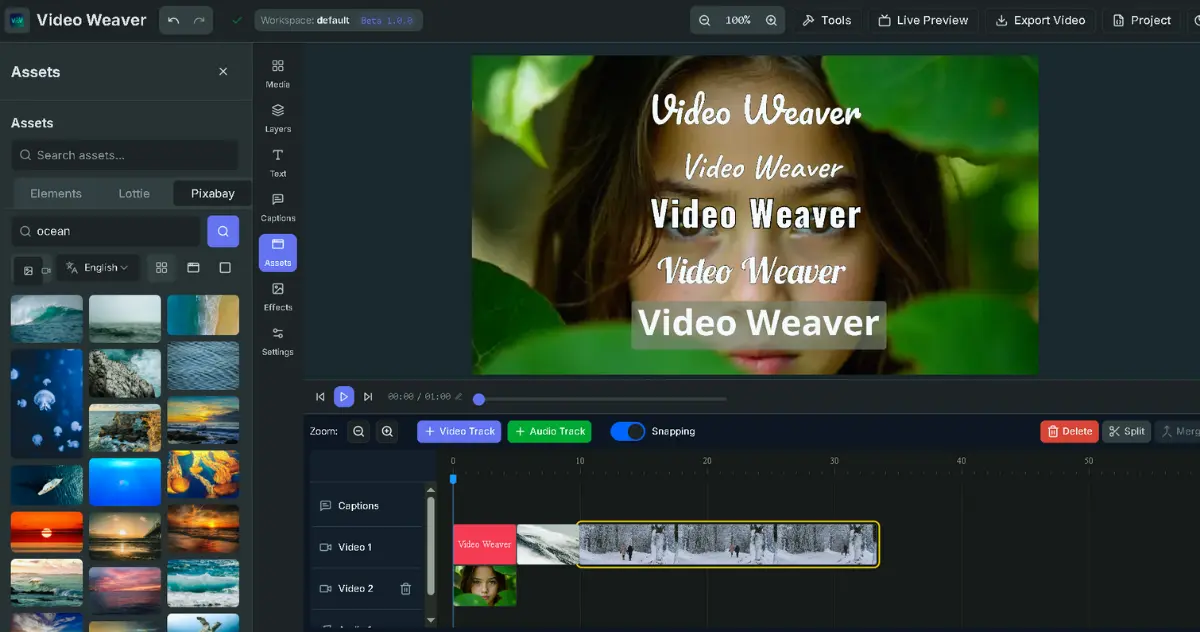
videoweaver.app
Video Weaver: Professional video editing directly in your browser. No downloads required.
Learn MoreDMflow.chat
Discover DMflow.chat and unlock the new era of AI-powered customer service.
Learn MoreDMflow.chat
DMflow.chat: Your intelligent AI partner for exceptional customer engagement.
Learn Morevideoweaver.app
Video Weaver: Professional video editing directly in your browser. No downloads required.
Learn More